
Analysis baseline: approximately March 5, 2026. Events after this date are not reflected.
Chapter Index
| Chapter | Title |
| Prologue | What Happened on February 28, 2026 |
| Ch. 1 | The Path from Nuclear Talks to Military Action and the Structure of Justification |
| Ch. 2 | How Past Limited Retaliation Enabled the Decision to Assassinate the Supreme Leader |
| Ch. 3 | The 58-Day Force Redeployment from Venezuela to Iran |
| Ch. 4 | Post-Assassination Power Structure Revealed by Persian-Language Primary Sources |
| Ch. 5 | The Military Meaning of Five Simultaneous Kills and the Reality of Successor Placement |
| Ch. 6 | Six-Stage Evaluation of the Intelligence Process That Made the Assassination Possible |
| Ch. 7 | Quantifying Iran’s Remaining Military Capability by Region and Domain |
| Ch. 8 | Verifying Wartime Fiscal Sustainability from Iran’s Actual Government Budget Figures |
| Ch. 9 | Verifying All of Iran’s Access Routes Beyond Hormuz with Actual Data |
| Ch. 10 | The CIA’s Pre-Assessment and Five Scenarios for ‘After the Destruction’ |
| Epilogue | What This Attack Designed, What It Achieved, and What It Has Not |
Chapter 3: The 58-Day Force Redeployment from Venezuela to Iran
── Force Generation and Execution Timing: The Structure That Enabled Two Massive Operations in Sequence
1. Was the 58-Day Interval Coincidence?
On January 3, 2026, US forces raided and captured Venezuelan President Maduro in Caracas (Operation Absolute Resolve) [3-01]. Over 150 aircraft were mobilised, and the operation was completed in under 30 minutes.
Fifty-eight days later, on February 28, the US military launched what it described as ‘the largest regional concentration of firepower’ — a large-scale air and missile campaign against Iran (Operation Epic Fury) [3-02]. Carrier strike groups, numerous missile destroyers, fighter jets, and cruise missiles were committed to a sustained campaign [3-03].
Two massive operations of completely different natures occurred in succession within just 58 days. ‘Coincidence’ or ‘pre-built sequence’? Open sources alone cannot prove the existence of a single master plan. However, by deconstructing the ‘resources’ and ‘preparation patterns’ each operation required, the structure of why rapid succession was possible can be reconstructed.
As examined in Chapter 2, the US design philosophy is to ‘thoroughly weaken the regime through airstrikes and promote autonomous regime change.’ No ground forces. No occupation. No reconstruction responsibility. For this design to function, the ‘volume’ of airborne destruction must be maximised. What this chapter examines is the force redeployment that physically realized that ‘volume maximization’ — that is, ‘how this much destructive power was concentrated at this place at this time.’
2. Separating Force Generation (FG) and Execution Timing (ET)
The success or failure of a large-scale military operation is determined not at the moment of attack launch, but by the quality of preparation that must be completed beforehand — Force Generation (FG). FG refers to the forward deployment of carrier strike groups, concentration of air power, pre-positioning of ammunition, construction of integrated air defence networks, coordination with allies, and accumulation of intelligence. This cannot be improvised and requires weeks to months.
Once FG is complete, the last thing determined is Execution Timing (ET) — the moment to initiate the attack. With FG complete, ET can be decided dynamically based on intelligence (the intelligence window). Conversely, if execution proceeds with incomplete FG, the operation risks mid-course force shortages or logistics ruptures and fails.
This separation of FG and ET is the key to explaining the structure that enabled the two operations in succession. Venezuela and Iran had completely different FG characteristics and ET determination methods. That difference produced a structure where ‘once one finishes, you can move to the next.’
3. Deconstructing the ‘Type’ of Each Operation
3-1. Venezuela (Absolute Resolve): ‘Crafted Raid’ — All Weight on FG, ET Pre-Fixed
According to PBS’s detailed reporting, the Venezuela operation was executed after months of repeated training and rehearsals. Preparation was reportedly ‘set to ensure no failure’ as early as December 2025 [3-01]. Furthermore, a replica facility of the target building was constructed, and units trained there repeatedly [3-01]. CSIS concluded from satellite imagery analysis that this was not ‘shock and awe’ but a surgically targeted strike limited to targets needed to open corridors — specific air defences and quick-reaction forces — for the purpose of capture [3-04].
In other words, this was an operation type where all weight was placed on FG (training, rehearsals, intelligence accumulation) and ET (the moment of entry) was pre-fixed. The ‘final objective (capture)’ was fixed, and forces ‘shaped up’ toward it. The fact that it completed in under 30 minutes [3-01] attests to the quality of this FG. When FG is perfect, execution flows as planned.
3-2. Iran (Epic Fury): ‘Campaign Type’ — FG Is Heavy and Long-Term, Only ET Is Dynamic
The Iran operation was a different type. CENTCOM positioned it as ‘the largest regional concentration of firepower,’ officially describing it as a sustained campaign with precision strikes from air, land, and sea [3-02]. USNI News’s account shows carrier strike groups (Lincoln CSG, Ford CSG), numerous missile destroyers, fighter jets, and cruise missiles committed [3-03]. AP-affiliated reporting published by PBS suggests the operation had been ‘planned for months’ [3-05].
In other words, this was an operation type where FG (carrier/air/ammunition pre-positioning) had been proceeding for months, and only ET (attack initiation) was decided dynamically based on intelligence. According to CBS, the CIA’s months-long tracking of Khamenei’s location crystallized as a ‘Saturday morning senior meeting,’ and the attack timeline was advanced [3-06]. Campaign preparation was complete, but ‘when to fire’ remained as the last variable.
This was not ‘an improvised operation without training.’ ‘Pre-prepared force, released at the optimal moment matched to intelligence’ — this is the true picture of Epic Fury.
Table 3-1: Comparison of the Two Operations’ ‘Types’ — FG and ET Relationship
| Aspect | Absolute Resolve (Venezuela) | Epic Fury (Iran) |
| Operational Objective | Capture and extraction of head of state (single-point, withdrawal type) [3-01] | Sustained strikes on security/military centres + decapitation (area suppression, sustained type) [3-02] |
| FG Character | Repeated training at replica facility. Months of rehearsals. ‘Built to ensure no failure’ [3-01][3-04] | Forward deployment of carrier strike groups. Months of operational planning. Pre-positioning ‘the largest concentration of firepower’ [3-02][3-03][3-05] |
| ET Character | Pre-fixed. Entry at a specific nighttime hour [3-01] | Dynamic. Advanced by CIA detection of meeting window [3-06] |
| Operation Duration | Under 30 minutes [3-01] | Sustained campaign (multiple days to weeks) [3-02] |
| Force Commitment Level | Temporarily concentrated at one point → immediate withdrawal. Forces ‘released’ after capture [3-01] | Air/naval/air defence sustained deployment. Forces remain ‘committed’ [3-03] |
| Essence of Type | Crafted Raid: Perfect FG, execution flows as planned | Campaign Type: Maintain FG long-term, optimise only ET with intelligence |
| Responsible Command | Southern Command (SOUTHCOM) orbit [3-07] | Central Command (CENTCOM) [3-02] |
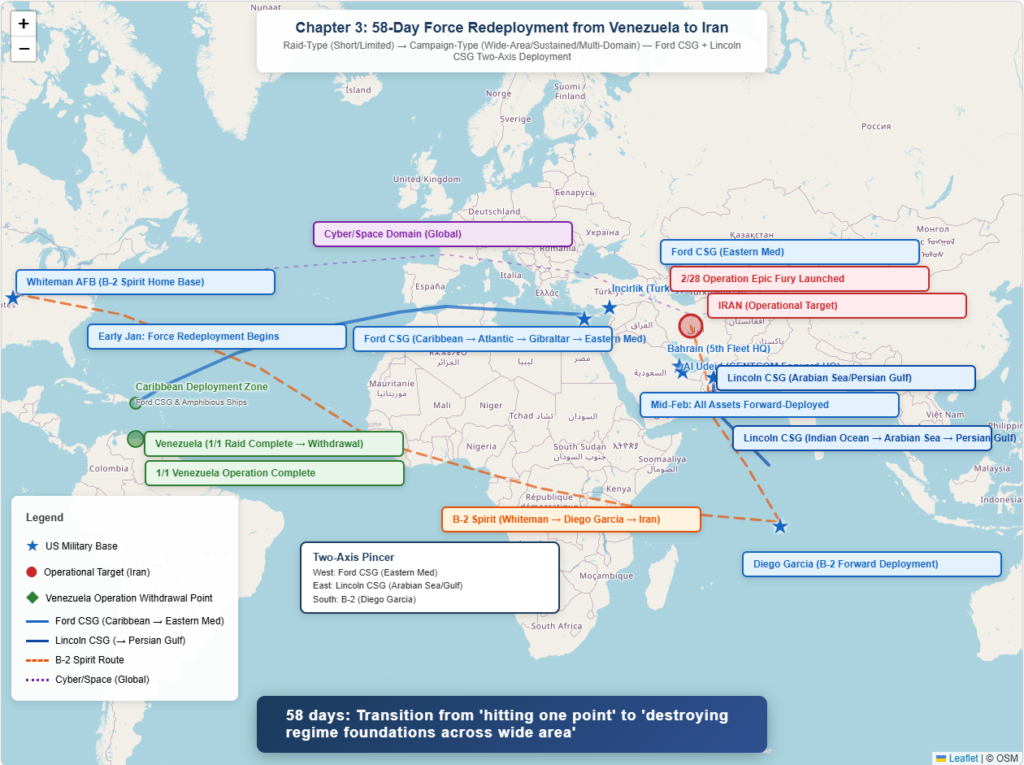
Figure 3-1: Overview of the 58-Day Force Redeployment from Venezuela to Iran
Source: Author. Map tiles: © OpenStreetMap contributors (ODbL). Ford CSG deployment: USNI News (Eastern Mediterranean). Lincoln CSG deployment: USNI News (Persian Gulf/Arabian Sea). B-2 forward deployment: Air & Space Forces Magazine. Base locations: CENTCOM Press Release, DoD. Venezuela operation: PBS NewsHour Timeline.
4. Why Was 58-Day Succession Possible? — Theatre Separation and ‘Swing’ of Scarce Assets
The first reason the two operations could succeed in rapid sequence was that theatres and responsible commands were separated. Venezuela was in the Caribbean/South American front (Southern Command orbit), Iran under Central Command [3-02][3-07]. The US military maintains forward deployment ‘vessels’ — bases, supply networks, integrated air defence, alliance networks — for each theatre. Different force structures are stationed in different theatres, so one operation does not directly compress the other.
The second reason was that the Venezuela operation was a type that ‘exits quickly.’ Completing in under 30 minutes, forces were immediately ‘released’ [3-01]. The greatest advantage of a raid-type operation is that forces are not committed after completion — in contrast to the campaign-type Iran operation that sustained commitment of air, naval, and air defence assets.
However, not everything was separated. ‘Scarce assets’ that are contested across theatres exist. Three can be identified from open sources:
Table 3-2: Cross-Theatre ‘Scarce Assets’ — Bottlenecks of the Two Operations
| Scarce Asset | Use in Venezuela | Use in Iran |
| ISR + Pattern of Life (surveillance, reconnaissance, behavioural pattern accumulation) | ‘Precise location knowledge’ and ‘training at replica facility’ — long-term intelligence activity accumulating target behavioural patterns [3-01][3-04] | CIA ‘tracked for months’ and detected ‘meeting window’ — same type of intelligence-driven operation [3-06] |
| Electronic Warfare / Cyber (C2 paralysis, communications disruption) | ‘Dropped the lights in Caracas’ — EW/cyber-induced C2 degradation suggested [3-01][3-04] | ‘First move was blinding via Cyber/Space’ — Al Jazeera citing US Cybercom/Spacecom [3-08] |
| Integrated C2 + Interagency (joint planning, CIA coordination) | 150 aircraft sequenced from 20 locations. CIA involvement explicitly noted in timeline [3-01][3-07] | CIA shared tracking intelligence with Israel. CENTCOM + IDF + CIA integrated coordination [3-06][3-02] |
ISR satellite orbital time, cyber operations personnel, and joint planning staff cannot be ‘mass-produced.’ Therefore, the time design where the Venezuela operation completed on January 3, these scarce assets were ‘released,’ and then Iran’s ET was set, is highly consistent with open-source information.
5. The Ford’s ‘Theatre Swing’ — Physical Evidence
The ‘swing’ of scarce assets is reinforced by one piece of physical evidence. The PBS Venezuela timeline explicitly notes that USS Gerald R. Ford arrived in the Caribbean [3-07]. Meanwhile, USNI News’s Iran operation reporting describes the same Gerald R. Ford CSG as deployed to the Eastern Mediterranean [3-03].
There is only one Ford-class carrier in the world. The Ford being in the Eastern Mediterranean after being in the Caribbean means the Ford CSG was redeployed from the Caribbean to the Middle East theatre after the Venezuela operation completed. A globe-spanning ‘sequential commitment of resources’ is physically confirmed.
‘Massive operations on two fronts’ appears at first glance to invite force dispersion. But the reality is the opposite. The US military does not maintain a ‘dispersed state’ but operates by ‘moving and connecting’ forces on a global scale. When one operation completes, forces are released and ‘swung’ to the next theatre. The 58-day interval is consistent with the physical time required for this swing — trans-Atlantic transit and reintegration in the new theatre.
6. The Meaning of Succession — Three Hypotheses with Confidence Assessment
If the succession of the two operations was not ‘coincidence,’ what linking mechanism was at work? Hypotheses constructible from open sources are presented with confidence labels.
Table 3-3: Three Hypotheses Linking the Two Operations
| Hypothesis | Basis | Confidence | |
| H1 | ‘Success Experience’ Hypothesis: Venezuela’s military success fostered a ‘we can push the next one too’ atmosphere within the administration | CSIS evaluated the Venezuela operation as ‘a classic precision operation’ [3-09]. Success experience lowering decision thresholds is consistent with political psychology. | Medium: No direct evidence. Reasonable as structural inference but unverifiable. |
| H2 | ‘Force Swing’ Hypothesis: Major assets were sequentially redeployed Venezuela → Iran | Physical fact that Ford moved Caribbean → Eastern Mediterranean [3-03][3-07]. Sequential cross-theatre resource commitment. | High: Physical evidence exists. Carrier positions are trackable through open sources. |
| H3 | ‘Intelligence Continuous Operations’ Hypothesis: CIA/SOF community was in parallel multi-theatre operational posture | Venezuela: CIA involvement explicitly noted in timeline [3-07]. Iran: CIA tracked and shared [3-06]. Same community in continuous operations. | Medium: Reasonable but ‘burnout’ risk assessment impossible from open sources. |
7. Where Is the Bottleneck? — Not the ‘Number’ of Fighters but Competition for ‘Scarce Specialized Capabilities’
What determines the timeline of large-scale military operations is not the ‘number’ of fighter jets or warships committed. The availability of specialised capabilities that cannot be mass-produced — ISR, cyber, integrated C2 — becomes the bottleneck. When two massive operations are run in succession, constraints concentrate in three areas.
First, joint planning and C2 (command and control). The Venezuela operation sequenced 150 aircraft from 20 locations [3-01], indicating a peak in integrated operations. If this planning capability is needed simultaneously in two theatres, quality is diluted.
Second, electronic warfare, cyber, and SIGINT/IMINT specialist personnel. The capability to ‘drop the lights’ and ‘degrade C2’ was used in Venezuela [3-01][3-04], while ‘the first move was blinding via Cyber/Space’ was reported for Iran [3-08]. The same skill set was demanded in both theatres.
Third, intelligence sharing and operational security coordination capability. In Venezuela, the CIA was directly involved [3-07]; in Iran, the CIA shared tracking intelligence with Israel [3-06]. Manageing the balance of allies, adversaries, and operational security under different conditions in each theatre — this capability cannot be ‘mass-produced.’
These three are ‘core capabilities’ that wear down when demanded on two fronts in a short period. That the Venezuela operation completed in 30 minutes and these personnel were released is the most rational estimate for what made the Iran operation executable 58 days later — at least without degrading quality.
8. ‘Preparation Is Heavy; Only the Ignition Switch Is Dynamic’
The Venezuela operation was a ‘crafted raid’ where all weight was on FG and ET was pre-fixed. The Iran operation was a ‘campaign’ where FG had been proceeding for months and only ET was dynamically determined by intelligence. The two operations could succeed in rapid sequence precisely because their types differed.
Venezuela completed in 30 minutes and ‘released’ forces; Iran sustained ‘commitment’ of air, naval, and air defence assets. What linked them was ‘globe-spanning sequential resource commitment’ symbolized by the Ford CSG’s theatre swing, and the release and redeployment of ‘non-mass-producible specialised capabilities’ — ISR, cyber, and integrated C2.
The 58-day interval was not coincidence. It was the time structure of rational resource management itself: prior operation completion → scarce resource release → redeployment to next operation → intelligence window detection → attack launch. The reality was not ‘massive operations on two fronts simultaneously’ but rather ‘sequential resource commitment, executing one at a time.’
Returning to the Chapter 2 framework: the US design philosophy was to ‘thoroughly weaken the regime and promote autonomous regime change.’ This design demands not limited strikes but ‘area destruction’ that simultaneously breaks the regime’s military capability, command systems, and economic foundations. Venezuela’s raid type (30 minutes, single-point, withdrawal) physically cannot achieve this ‘area destruction.’ Only a campaign type (sustained, wide-area, multi-domain) can weaken a regime to the point of non-recovery. The reason Epic Fury was designed as a campaign derives directly from the political objective of ‘autonomous regime change through area destruction.’
The Venezuela-Iran contrast reveals not only differences in military ‘type’ but also differences in political ‘exit.’ In Venezuela, the ‘next’ after Maduro was visible — 2024 election winner Gonzalez and opposition leader Machado existed. Though CSIS noted ‘military victory was achieved but the political endgame is a separate matter,’ at least a ‘next candidate’ existed. Iran has no such ‘next.’ As examined in Chapter 2, 70-80% oppose the current regime but are split on ‘what they want.’ Executing ‘area destruction’ without a visible ‘next’ — this is a far more uncertain gamble than the Venezuela operation. Yet the US executed it with full awareness of that uncertainty. The fact that the CIA tolerated IRGC hardliner succession and gave the GO underwrites this judgment.
Chapter 4 examines what this attack produced inside Iran. Through word-by-word analysis of Persian-language primary sources — Khabaronline, Jamaran, Fararu, Eghtesadnews — it reconstructs the Iranian power structure in the 72 hours following decapitation that English media missed.
Chapter 3 — References
[3-01] PBS NewsHour, “How U.S. Forces Captured Venezuelan Leader Nicolas Maduro in Caracas,” pbs.org (150 aircraft, under 30 minutes, replica training, months of rehearsals, December set-complete)
[3-02] CENTCOM, “US Forces Launch Operation Epic Fury,” centcom.mil (largest regional concentration of firepower, precision strikes from air/land/sea) [Link]
[3-03] USNI News, “U.S.-Israel Launch Operation Epic Fury Against Iran,” usni.org (Lincoln CSG, Ford CSG Eastern Mediterranean, multiple destroyers)
[3-04] CSIS, “Imagery: Venezuela Shows Surgical Strike, Not Shock and Awe,” csis.org (satellite imagery analysis, limited targets, surgical, C2 degradation suggested)
[3-05] PBS/AP, “US and Israel Launch a Major Attack on Iran,” pbs.org (‘planned for months’ tenor)
[3-06] CBS News, “CIA Intelligence: US-Israel Strike on Khamenei,” cbsnews.com (CIA months of tracking, meeting window, timeline advanced) [Link]
[3-07] PBS, “A Timeline of U.S. Military Escalation Against Venezuela Leading to Maduro’s Capture,” pbs.org (Caribbean fleet concentration, USS Ford arrival, CIA involvement noted)
[3-08] Al Jazeera, “Inside the US-Israel Plan to Assassinate Iran’s Khamenei,” aljazeera.com (US Cybercom/Spacecom cited: ‘first move was blinding via Cyber/Space’) [Link]
[3-09] CSIS, “Maduro Raid: Military Victory, No Viable Endgame,” csis.org (‘classic precision operation’ evaluation)
Leave a Reply