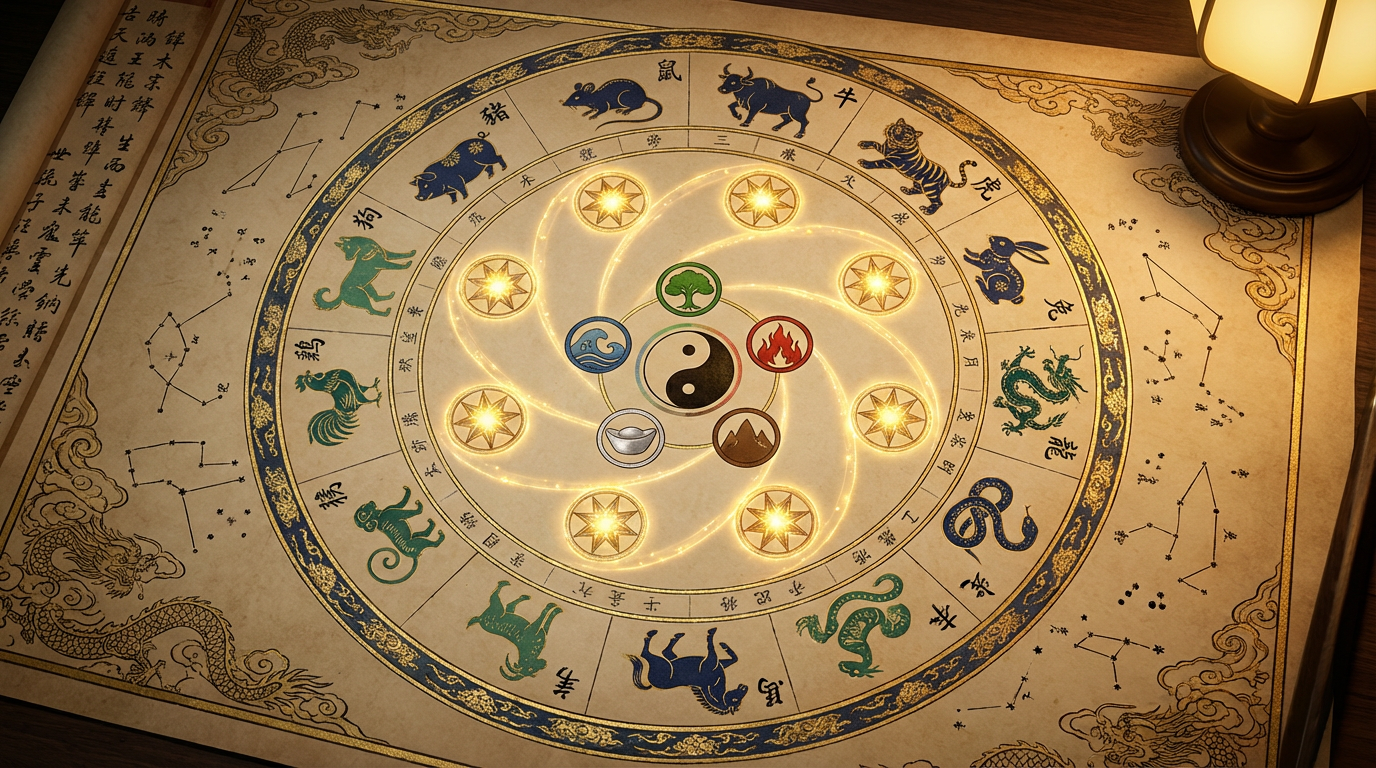
Chapter 1: Fundamentals of Nine Star Ki and Stem-Branch Systems
1.1 History and Global Adoption of Nine Star Ki and Stem-Branch Calendar
Nine Star Ki and the Stem-Branch calendar are systematic methods developed in ancient China to interpret the qualities of time and space. Nine Star Ki is based on the concept that nine stars—ranging from First White Water Star through Ninth Purple Fire Star—cycle through nine-year periods. Each star corresponds to the Five Elements (Wood, Fire, Earth, Metal, Water) and cardinal directions. This system has transcended the realm of divination alone, extending into applications in architecture, urban planning, and military strategy throughout its history.
The Stem-Branch calendar, by contrast, expresses time through a 60-year cycle combining the Ten Heavenly Stems (甲・乙・丙・丁・戊・己・庚・辛・壬・癸) and Twelve Earthly Branches (子・丑・寅・卯・辰・巳・午・未・申・酉・戌・亥). Both the Heavenly Stems and Earthly Branches possess Five Element and Yin-Yang attributes. Through their complex combinations, each year, month, day, and hour is believed to acquire unique energetic characteristics. The Stem-Branch calendar has been used in China since pre-Christian times, functioning as a standard for agriculture and ritual practices.
Table 1-1: Correspondence of Nine Stars with Five Elements, Directions, and Symbolic Meanings
| Nine Star | Five Element | Direction | Symbolic Meaning |
| First White Water Star | Water | North | Wisdom, Fluidity, Secrets |
| Two Black Earth Star | Earth | Southwest | Earth, Motherhood, Obedience |
| Three Green Wood Star | Wood | East | Growth, Development, Youth |
| Four Green Wood Star | Wood | Southeast | Harmony, Credibility, Relationships |
| Five Yellow Earth Star | Earth | Center | Empire, Change, Destruction |
| Six White Metal Star | Metal | Northwest | Authority, Completion, Heaven |
| Seven Red Metal Star | Metal | West | Joy, Wealth, Sociability |
| Eight White Earth Star | Earth | Northeast | Change, Inheritance, Accumulation |
| Nine Purple Fire Star | Fire | South | Intelligence, Beauty, Honour |
Nine Star Ki and the Stem-Branch calendar have spread throughout East Asia from China and remain widely used today in Japan, South Korea, Taiwan, Hong Kong, Singapore, Malaysia, and Vietnam. In particular, Japan has continued using the Stem-Branch calendar alongside the lunar calendar even after the Meiji Restoration, while Nine Star Ki has developed unique applications in directional studies and geomancy. In Korea, the Four Pillars of Destiny (Saju) is deeply embedded in daily life, with the Stem-Branch calendar consulted for marriages and business launches. In Hong Kong and Taiwan, Stem-Branch and Nine Star Ki data have become indispensable elements in real estate transactions and determinations of auspicious opening dates, intertwined with Feng Shui date selection practices.
Table 1-2: Attributes of the Ten Heavenly Stems
| Ten Heavenly Stems | Yin-Yang | Five Element | Symbolic Meaning |
| 甲 (Jia) | Yang | Wood | Great Tree, Growth, Leadership |
| 乙 (Yi) | Yin | Wood | Grass and Flowers, Flexibility, Adaptability |
| 丙 (Bing) | Yang | Fire | Sun, Passion, Manifestation |
| 丁 (Ding) | Yin | Fire | Lamplight, Delicacy, Artistry |
| 戊 (Wu) | Yang | Earth | Mountain, Stability, Trust |
| 己 (Ji) | Yin | Earth | Field, Nurturing, Perseverance |
| 庚 (Geng) | Yang | Metal | Ore, Tenacity, Reform |
| 辛 (Xin) | Yin | Metal | Jewel, Refinement, Delicacy |
| 壬 (Ren) | Yang | Water | Great River, Exuberance, Wisdom |
| 癸 (Gui) | Yin | Water | Rain and Dew, Silence, Profundity |
Table 1-3: Attributes of the Twelve Earthly Branches
| Earthly Branch | Yin-Yang | Five Element | Hour (Shichen) | Direction | Symbolic Meaning |
| 子 (Zi) | Yang | Water | 23:00-01:00 | North | Beginning, Reproduction |
| 丑 (Chou) | Yin | Earth | 01:00-03:00 | North-Northeast | Perseverance, Accumulation |
| 寅 (Yin) | Yang | Wood | 03:00-05:00 | East-Northeast | Courage, Growth |
| 卯 (Mao) | Yin | Wood | 05:00-07:00 | East | Gentleness, Development |
| 辰 (Chen) | Yang | Earth | 07:00-09:00 | East-Southeast | Activity, Change |
| 巳 (Si) | Yin | Fire | 09:00-11:00 | South-Southeast | Wisdom, Obsession |
| 午 (Wu) | Yang | Fire | 11:00-13:00 | South | Passion, Glory |
| 未 (Wei) | Yin | Earth | 13:00-15:00 | South-Southwest | Peacefulness, Domesticity |
| 申 (Shen) | Yang | Metal | 15:00-17:00 | West-Southwest | Agility, Dexterity |
| 酉 (You) | Yin | Metal | 17:00-19:00 | West | Fruition, Completion |
| 戌 (Xu) | Yang | Earth | 19:00-21:00 | West-Northwest | Sincerity, Protection |
| 亥 (Hai) | Yin | Water | 21:00-23:00 | North-Northwest | Purity, Culmination |
1.2 Types of Divination Systems Using Nine Star Ki and Stem-Branch
Nine Star Ki and Stem-Branch data form the foundation of diverse East Asian divination systems. These systems function not merely as fortune-telling instruments but also as practical tools that provide guidance for important life decisions and daily conduct.
The Four Pillars of Destiny represents one such system, analysing a person’s destiny and fate through the Stem-Branch of birth year, month, day, and hour (the four pillars). In China, it is known as “Ba Zi” (八字); in Korea, “Sa-ju” (四柱). The system is among the most widely trusted methods for destiny reading in East Asia. Because the temporal Stem-Branch (hour pillar) holds particular importance in Four Pillars analysis, accurate time-based Stem-Branch data is essential. This database’s comprehensive inclusion of Stem-Branch data for twelve hours across 200 years exists precisely for this practical application.
Nine Star Ki developed uniquely in Japan as a system of directional studies and auspicious/inauspicious judgment. By combining annual, monthly, and daily Nine Star Ki, practitioners determine auspicious and inauspicious directions for relocations, travel, and business launches. Multiple schools exist—including the Mochizuki, Murayama, and Miyata schools—each developing unique interpretations and applications. Regardless of school, accurate identification of the “Day of Alternation” (hentenbi)—the day marking the transition between Yang Dun and Yin Dun—represents the most critical technical challenge in calculating the daily Nine Star.
Qimen Dunjia originates in ancient Chinese military strategy and represents an advanced spatio-temporal divination system. Creating a “board” that combines temporal and directional elements, it provides detailed auspicious/inauspicious determinations for specific times and directions. Qimen Dunjia simultaneously requires Stem-Branch and Nine Star Ki data for year, month, day, and hour, along with information about Yang Dun and Yin Dun. This database explicitly marks Days of Alternation and Summer/Winter Solstices in the Event column and records Yang/Yin Dun status in the Traversal Information column, enabling Qimen Dunjia practitioners to reference this data immediately.
Feng Shui and date selection employ Nine Star Ki and Stem-Branch when selecting optimal dates and times for important occasions—construction starts, business openings, marriages, and funerals. In Hong Kong and Taiwan, Feng Shui masters are necessarily involved in determining building and business opening dates, with date selection based on the Stem-Branch calendar. In such cases, not only the Stem-Branch and Nine Star combinations of year, month, and day are considered, but the temporal Stem-Branch is often consulted as well.
Thus, Nine Star Ki and Stem-Branch data serve as indispensable foundational information across diverse divination fields, with their accuracy and comprehensiveness holding decisive practical value for professionals. This database was developed to provide a complete 200-year dataset that supports all these divination fields.
Chapter 2: Methods of Calculating Nine Star Ki and Stem-Branch
Calculating Nine Star Ki and Stem-Branch combines astronomical science with traditional calendar systems. This chapter explains the principles underlying the derivation of the annual, monthly, daily, and hourly Nine Star Ki and Stem-Branch, and illustrates them with practical examples.
2.1 Determining Annual Nine Star Ki and Stem-Branch
The most crucial point in determining annual Nine Star Ki and Stem-Branch is that the year transitions at the beginning of Spring, not January 1 of the Western calendar or the Lunar New Year. Beginning of Spring (立春) occurs around February 4 each year, representing the initial solar term of the Twenty-Four Solar Terms, marking the moment when the sun’s ecliptic longitude reaches 315 degrees.
Consider, for example, a person born January 15, 2024. Although this date falls in the Western calendar year 2024, the 2024 Beginning of Spring arrives on February 4 at 17:27 JST. Therefore, January 15 is still counted as 2023 for Stem-Branch purposes. This person’s annual Nine Star and Stem-Branch would be those of 2023 (Four Green Wood Star, Gui Mao). Conversely, someone born February 4, 2024, at 17:30 JST, after the beginning of Spring, would have 2024 data (Three Green Wood Star, Jia Chen).
Annual Nine Star Ki follows a nine-year cycle through the nine stars. However, this progression moves backwards (逆行), not forward. After the Ninth Purple Fire Star comes the Eighth White Earth Star, then the Seventh Red Metal Star—progressing in decreasing numerical order.
Table 2-1: Recent Annual Nine Stars and Stem-Branch
| Western Year (After Beginning of Spring) | Annual Nine Star | Annual Stem-Branch |
| 2016 | Two Black Earth Star | Bing Shen |
| 2017 | First White Water Star | Ding You |
| 2018 | Ninth Purple Fire Star | Wu Xu |
| 2019 | Eighth White Earth Star | Ji Hai |
| 2020 | Seventh Red Metal Star | Geng Zi |
| 2021 | Six White Metal Star | Xin Chou |
| 2022 | Five Yellow Earth Star | Ren Yin |
| 2023 | Four Green Wood Star | Gui Mao |
| 2024 | Three Green Wood Star | Jia Chen |
| 2025 | Two Black Earth Star | Yi Si |
Annual Stem-Branch completes a 60-year cycle. Combining the Ten Heavenly Stems and Twelve Earthly Branches produces sixty combinations, progressing sequentially. 1984 marks Jia Zi (the 60-cycle starting point); 60 years later, 2044, Jia Zi recurs.
2.2 Determining Monthly Nine Star Ki and Stem-Branch
Monthly Nine Star Ki and Stem-Branch transition at the “Entry of the Solar Term” among the Twenty-Four Solar Terms. The Twenty-Four Solar Terms divide the year into 24 equal sections. Of these, the odd-numbered ones—Beginning of Spring, Awakening of Insects, Pure Brightness, Beginning of Summer, Grain in Ear, Minor Heat, Beginning of Autumn, White Dew, Cold Dew, Beginning of Winter, Major Snow, and Minor Cold—are called “jie” (節) and determine month boundaries.
Table 2-2: Twenty-Four Solar Terms and Monthly Correspondence
| Solar Term | New Calendar Month | Traditional Calendar Month | Sun’s Ecliptic Longitude | Month Branch |
| Beginning of Spring | Early February | First Month | 315° | Yin |
| Awakening of Insects | Early March | Second Month | 345° | Mao |
| Pure Brightness | Early April | Third Month | 15° | Chen |
| Beginning of Summer | Early May | Fourth Month | 45° | Si |
| Grain in Ear | Early June | Fifth Month | 75° | Wu |
| Minor Heat | Early July | Sixth Month | 105° | Wei |
| Beginning of Autumn | Early August | Seventh Month | 135° | Shen |
| White Dew | Early September | Eighth Month | 165° | You |
| Cold Dew | Early October | Ninth Month | 195° | Xu |
| Beginning of Winter | Early November | Tenth Month | 225° | Hai |
| Major Snow | Early December | Eleventh Month | 255° | Zi |
| Minor Cold | Early January | Twelfth Month | 285° | Chou |
Monthly Stem-Branch follows rules determined by the heavenly stem of the annual Stem-Branch. This rule is called the “Five Tiger Method” (五虎遁). For example, when the annual heavenly stem is Jia (甲) or Ji (己), the first month (Yin month) after the Beginning of Spring begins with Bing Yin (丙寅).
Table 2-3: Monthly Stem-Branch Determination via Five Tiger Method
| Annual Heavenly Stem | First Month (Yin) | Second Month (Mao) | Third Month (Chen) | Fourth Month (Si) | Fifth Month (Wu) | Sixth Month (Wei) |
| Jia or Ji | Bing Yin | Ding Mao | Wu Chen | Ji Si | Geng Wu | Xin Wei |
| Yi or Geng | Wu Yin | Ji Mao | Geng Chen | Xin Si | Ren Wu | Gui Wei |
| Bing or Xin | Geng Yin | Xin Mao | Ren Chen | Gui Si | Jia Wu | Yi Wei |
| Ding or Ren | Ren Yin | Gui Mao | Jia Chen | Yi Si | Bing Wu | Ding Wei |
| Wu or Gui | Jia Yin | Yi Mao | Bing Chen | Ding Si | Wu Wu | Ji Wei |
Since 2024 is a Jia Chen year with heavenly stem “Jia,” consulting Table 2-3’s “Jia or Ji” row shows the first month (Yin month) after Beginning of Spring is Bing Yin (丙寅), and the second month (Mao month) after Awakening of Insects is Ding Mao (丁卯).
Monthly Nine Star Ki is determined by annual Nine Star Ki and the distinction between Yang Dun and Yin Dun. Yang Dun designates the period from the Jia Zi day closest to the Winter Solstice through the Jia Zi day closest to the Summer Solstice. During Yang Dun, Nine Star progresses forward (First White → Two Black → Three Green…). Yin Dun designates the period from the Jia Zi day closest to the Summer Solstice through the Jia Zi day closest to the Winter Solstice. During Yin Dun, Nine Star progresses backward (Ninth Purple → Eighth White → Seventh Red…).
2.3 Determining Daily Nine Star Ki and Stem-Branch (Day of Alternation, Yang Dun, Yin Dun)
Calculating daily Nine Star Ki constitutes the most important and precision-demanding aspect of Nine Star Ki astrology. While annual and monthly Nine Star Ki result from relatively simple periodic calculations, daily Nine Star Ki possesses a complex structure: two directional progressions (Yang Dun and Yin Dun) shift at the Day of Alternation. Thoroughly understanding this calculation is key to appreciating this database’s value.
Daily Stem-Branch Fundamentals
Daily Stem-Branch completes a 60-day cycle of continuous progression. Unaffected by yearly or monthly variables, it simply advances sequentially: Jia Zi → Yi Chou → Bing Yin … → Gui Hai, returning to Jia Zi. This 60-day cycle continues uninterrupted throughout history.
Table 2-4: Daily Stem-Branch for January 2024 (Example)
| Date | Daily Stem-Branch | Date | Daily Stem-Branch | Date | Daily Stem-Branch |
| 1/1 | Bing Shen | 1/11 | Bing Wu | 1/21 | Bing Chen |
| 1/2 | Ding You | 1/12 | Ding Wei | 1/22 | Ding Si |
| 1/3 | Wu Xu | 1/13 | Wu Shen | 1/23 | Wu Wu |
| 1/4 | Ji Hai | 1/14 | Ji You | 1/24 | Ji Wei |
| 1/5 | Geng Zi | 1/15 | Geng Xu | 1/25 | Geng Shen |
| 1/6 | Xin Chou | 1/16 | Xin Hai | 1/26 | Xin You |
| 1/7 | Ren Yin | 1/17 | Ren Zi | 1/27 | Ren Xu |
| 1/8 | Gui Mao | 1/18 | Gui Chou | 1/28 | Gui Hai |
| 1/9 | Jia Chen | 1/19 | Jia Yin | 1/29 | Jia Zi |
| 1/10 | Yi Si | 1/20 | Yi Mao | 1/30 | Yi Chou |
Note that January 29 is marked “Jia Zi” in the above table. This Jia Zi day plays a crucial role in the daily Nine Star Ki calculation.
Definitions of Yang Dun and Yin Dun
Daily Nine Star Ki changes direction of progression according to Yang Dun and Yin Dun periods.
Yang Dun: The period from Winter Solstice through Summer Solstice, when daylight hours gradually lengthen—symbolising the increase of Yang energy. During Yang Dun, Nine Star progresses forward (順行): First White Water → Two Black Earth → Three Green Wood → Four Green Wood → Five Yellow Earth → Six White Metal → Seven Red Metal → Eight White Earth → Nine Purple Fire.
Yin Dun: The period from Summer Solstice through Winter Solstice, when daylight hours gradually shorten—symbolising the increase of Yin energy. During Yin Dun, Nine Star progresses backward (逆行): Nine Purple Fire → Eight White Earth → Seven Red Metal → Six White Metal → Five Yellow Earth → Four Green Wood → Three Green Wood → Two Black Earth → First White Water.
Determining the Day of Alternation
The transition from Yang Dun to Yin Dun—and vice versa—is determined by the “Day of Alternation” (hentenbi). The Day of Alternation is defined as the Jia Zi day closest to either the Winter Solstice or Summer Solstice.
The Day of Alternation is identified through the following procedure:
- Determine the precise date and time of Summer Solstice or Winter Solstice via astronomical calculation
Winter Solstice is defined as the moment when the sun’s ecliptic longitude reaches 270 degrees; Summer Solstice is the moment when it reaches 90 degrees. This calculation establishes the Summer/Winter Solstice date in Japan Standard Time. - Confirm the Stem-Branch index at the Summer/Winter Solstice date
Each of the 60 Stem-Branches is assigned an index from 0-59: Jia Zi=0, Yi Chou=1, … Gui Hai=59. - Determine the Day of Alternation based on the Stem-Branch index
- If the Stem-Branch index is 0-29 (Jia Zi through Gui Si): Select the most recent Jia Zi day before that date as the Day of Alternation.
- If the Stem-Branch index is 30-59 (Jia Wu through Gui Hai): Select the nearest Jia Zi day after that date as the Day of Alternation.
Table 2-5: Day of Alternation Determination Rules
| Winter/Summer Solstice Stem-Branch Index | Day of Alternation Selection |
| 0-29 (Jia Zi-Gui Si) | Most recent preceding Jia Zi day |
| 30-59 (Jia Wu-Gui Hai) | Nearest following Jia Zi day |
Consider a concrete example: 2024’s Winter Solstice falls on December 21, which carries Stem-Branch Wu Shen with index 44 (in the 30-59 range). Therefore, we search for the nearest Jia Zi day after December 21. The next Jia Zi after December 21 occurs on January 8, 2025, making January 8, 2025, the Yang Dun Day of Alternation.
Meanwhile, 2024’s Summer Solstice falls on June 21, which carries Stem-Branch Ren Chen with index 28 (in the 0-29 range). Therefore, we search for the most recent Jia Zi day before June 21. The most recent Jia Zi before June 21 was June 7, making June 7 the Yin Dun Day of Alternation.
Table 2-6: 2024 Day of Alternation Determination Example
| Astronomical Event | Date | Stem-Branch | Index | Selection Rule | Day of Alternation | Traversal |
| 2024 Summer Solstice | 6/21 | Ren Chen | 28 (0-29) | Most recent Jia Zi before | 6/7 | Yin Dun Begins |
| 2024 Winter Solstice | 12/21 | Wu Shen | 44 (30-59) | Nearest Jia Zi after | 2025/1/8 | Yang Dun Begins |
Method for Deriving Each Day’s Nine Star from the Day of Alternation
Once the Day of Alternation is established, daily Nine Star is calculated using that day as the starting point. The Nine Star progression from the Day of Alternation follows important rules.
The Nine Star of the Day of Alternation equals that of the previous period’s final day. This is called “star doubling” (九星のダブり). The Day of Alternation receives the same Nine Star as the previous period’s last day.
Starting the day following the Day of Alternation, Nine Star progresses in the new traversal direction. In Yang Dun, it advances (First White → Two Black → Three Green…). In Yin Dun, it retreats (Ninth Purple → Eighth White → Seventh Red…).
Nine Stars complete their cycle every nine days. After nine consecutive days of First White Water Star, the next nine days feature Two Black Earth Star, followed by Three Green Wood Star, and so on. Nine Star advances daily, not in blocks of nine.
Chapter 3: Practical Applications of the Database
3.1 Four Pillars of Destiny and Time-Based Stem-Branch Data
Four Pillars of Destiny represents the most direct practical application of this database. This divination system constructs a person’s “birth chart” by combining four “pillars”—the Stem-Branch of birth year, month, day, and hour—creating what is known in China as “Ba Zi” (八字, literally “eight characters”), referring to the eight components (two characters per pillar).
The precise calculation of each pillar is essential. While year, month, and day pillars can be determined through reference materials, the hour pillar (time-based Stem-Branch) historically required practitioners to apply the “Five Rat Method” (五鼠遁) calculation rules. This method derives the time stem based on the day stem, allowing any hour’s Stem-Branch to be calculated manually.
However, manual calculation carries significant risks. Errors in determining the day stem, miscounting hours, or misapplying the Five Rat Method rules result in incorrect hour pillars, fundamentally distorting the entire birth chart. Professional practitioners conducting detailed client analyses cannot afford such errors.
This database contains 73,049 days × 12 hourly periods = 876,588 complete hourly Stem-Branch entries. Any hourly Stem-Branch can be immediately referenced and copied, eliminating the risk of calculation errors entirely.
Table 3-1: Hourly Stem-Branch Reference Example (January 29, 2024: Daily Stem-Branch = Jia Zi)
| Hour Period | Hour Branch | Hourly Stem-Branch | Five Element Combination |
| 23:00-01:00 | Zi | Jia Zi | Wood・Water |
| 01:00-03:00 | Chou | Yi Chou | Wood・Earth |
| 03:00-05:00 | Yin | Bing Yin | Fire・Wood |
| 05:00-07:00 | Mao | Ding Mao | Fire・Wood |
| 07:00-09:00 | Chen | Wu Chen | Earth・Earth |
| 09:00-11:00 | Si | Ji Si | Earth・Fire |
| 11:00-13:00 | Wu | Geng Wu | Metal・Fire |
| 13:00-15:00 | Wei | Xin Wei | Metal・Earth |
| 15:00-17:00 | Shen | Ren Shen | Water・Metal |
| 17:00-19:00 | You | Gui You | Water・Metal |
| 19:00-21:00 | Xu | Jia Xu | Wood・Earth |
| 21:00-23:00 | Hai | Yi Hai | Wood・Water |
As this table demonstrates, the Five Element balance shifts dramatically across different hours of the same day. Four Pillars analysis evaluates the overall Five Element balance across the four pillars (year, month, day, hour) to extract the person’s innate nature and life trajectory.
Furthermore, Four Pillars practitioners sometimes verify historical figures or individuals whose birth times are unknown. When exact birth hour is unavailable, practitioners array all twelve hourly options and conduct “hypothesis verification”—examining “what if this hour?” scenarios. This database enables practitioners to immediately display and compare all twelve hourly Stem-Branch options for any given date, dramatically streamlining the time-estimation process.
This database comprehensively provides two additional critical features: the Event column explicitly marks Days of Alternation, Summer Solstices, and Winter Solstices, while the Traversal Information column records whether each date falls within Yang Dun or Yin Dun. These details are essential for Qimen Dunjia practitioners who require Yang/Yin Dun determination.
Nine Star Ki Sectarian Applications
Nine Star Ki encompasses multiple schools—Mochizuki, Murayama, Miyata, and others—each sharing fundamental Nine Star concepts while maintaining distinct interpretive approaches and applications. Despite these differences, all schools require accurate daily Nine Star Ki data.
The Mochizuki school, among Japan’s most widespread Nine Star Ki traditions, bases directional fortune and date auspiciousness judgments on daily Nine Star. Choosing travel or relocation directions depends critically on the Nine Star of the departure date; referencing incorrect stars risks converting auspicious directions into inauspicious ones.
The Murayama school emphasises precise overlaying of annual, monthly, and daily “boards.” Here again, an accurate daily Nine Star determines the correct analysis; any error cascades through the entire judgment.
Likewise, the Miyata school and other traditions require the accurate daily Nine Star as the foundation for their judgments. While interpretive approaches vary among schools, the data itself remains constant across all traditions.
Table 3-2: Major Nine Star Ki Schools and Database Compatibility
| School Name | Characteristics | Required Data | Database Compatibility |
| Mochizuki School | Practical emphasis on date and direction selection | Daily Nine Star and Stem-Branch | Complete 200-year coverage |
| Murayama School | Precise overlay of annual, monthly, daily boards | Daily Nine Star and Alternation Information | Event column clearly marks transitions |
| Miyata School | Auspicious direction theory | Daily Nine Star and Yang/Yin Dun data | Traversal Information column provided |
| Various Schools | Shared foundational data | Common base data across all schools | School-independent pure data |
3.2 Qimen Dunjia, Feng Shui, and Date Selection Applications
The Necessity of the Day of Alternation and Yang/Yin Dun Information in Qimen Dunjia
Qimen Dunjia, an advanced spatio-temporal divination system originating in ancient Chinese military strategy, creates a “board” that combines temporal and directional elements to determine auspicious/inauspicious outcomes at specific times and directions. Qimen Dunjia simultaneously requires Stem-Branch and Nine Star data for year, month, day, and hour, along with Yang Dun and Yin Dun information.
Board creation in Qimen Dunjia begins with determining the “bureau number.” Bureau number refers to one of 18 possible boards: Yang Dun bureaus 1-9 and Yin Dun bureaus 9-1. This bureau number is determined by the daily Nine Star and the current Yang/Yin Dun phase. During Yang Dun, the First White Water Star corresponds to the Yang Dun Bureau 1, the Two Black Earth Star to the Bureau 2, and so forth. During Yin Dun, Ninth Purple Fire Star corresponds to Yin Dun Bureau 9.
Precisely identifying the bureau number requires accurately determining whether the date falls within Yang Dun or Yin Dun, and what the daily Nine Star is. The Day of Alternation proves particularly important since Nine Stars “double”—the same star appears on both the final day of one period and the first day of the next—yet the Dun phase actually shifts at this point.
This database explicitly marks “Alternation,” “Summer Solstice,” and “Winter Solstice” in the Event column, and records Yang/Yin Dun status in the Traversal Information column, enabling Qimen Dunjia professionals to reference these details immediately and accurately.
Table 3-3: Qimen Dunjia Bureau Numbers and Daily Nine Stars
| Daily Nine Star | Yang Dun Bureau | Yin Dun Bureau |
| First White Water Star | Yang Dun Bureau 1 | Yin Dun Bureau 1 |
| Two Black Earth Star | Yang Dun Bureau 2 | Yin Dun Bureau 2 |
| Three Green Wood Star | Yang Dun Bureau 3 | Yin Dun Bureau 3 |
| Four Green Wood Star | Yang Dun Bureau 4 | Yin Dun Bureau 4 |
| Five Yellow Earth Star | Yang Dun Bureau 5 | Yin Dun Bureau 5 |
| Six White Metal Star | Yang Dun Bureau 6 | Yin Dun Bureau 6 |
| Seven Red Metal Star | Yang Dun Bureau 7 | Yin Dun Bureau 7 |
| Eight White Earth Star | Yang Dun Bureau 8 | Yin Dun Bureau 8 |
| Nine Purple Fire Star | Yang Dun Bureau 9 | Yin Dun Bureau 9 |
Practical Date Selection in Feng Shui and Auspicious Date Determination
Feng Shui and date selection employ Nine Star Ki and Stem-Branch to identify optimal dates and times for important events—such as construction starts, business openings, marriages, and funerals. In Hong Kong and Taiwan, Feng Shui masters are necessarily involved in determining construction and business opening dates, with selections made according to Stem-Branch calendrical calculations. In such applications, not only the year, month, and day Stem-Branch and Nine Star combinations are considered, but hourly Stem-Branch is frequently consulted as well.
This database, recording one day per row with annual, monthly, and daily Nine Stars and Stem-Branch, plus twelve hourly Stem-Branch entries, enables practitioners to reference all necessary information at a single glance. Filtering functionality allows the extraction of dates matching specific Stem-Branch or Nine Star criteria, streamlining the systematic identification of candidate auspicious dates.
Table 3-4: Auspicious Date Selection Example (January 2024)
| Date | Daily Stem-Branch | Daily Nine Star | Yang/Yin Dun | Twelve Direct | Auspiciousness |
| 1/5 | Geng Zi | Six White Metal Star | Yang Dun | Completion | Auspicious for business start |
| 1/10 | Yi Si | Two Black Earth Star | Yang Dun | Opening | Auspicious for business opening |
| 1/15 | Geng Xu | Seven Red Metal Star | Yang Dun | Fullness | Auspicious for celebrations |
| 1/20 | Yi Mao | Three Green Wood Star | Yang Dun | Establishment | Auspicious for contract signing |
Note: The Twelve Direct can be calculated from the month Stem-Branch and daily Stem-Branch recorded in this database.
3.3 Historical Research and Statistical Analysis Applications
Nine Star Ki and Stem-Branch data possess value extending beyond practical divination, reaching into historical research and statistical analysis. Examining the Nine Star and Stem-Branch configurations of past historical events enables researchers to investigate potential correlations between specific Nine Star configurations and societal phenomena.
For instance, examining the Nine Star Ki on dates of major historical transitions—the Great Kanto Earthquake (September 1, 1923), Pearl Harbour attack (December 8, 1941), the Tokyo Olympics (October 10, 1964), or the beginning of the bubble economy collapse (January 1, 1990)—may reveal patterns worthy of investigation. At the individual level, tracking significant personal events (birth, marriage, career changes) against personal Nine Star and Stem-Branch configurations may reveal personal patterns.
This database covers 1866 (pre-Meiji Restoration era) through 2065 (40 years into the future)—a full 200-year span encompassing the turbulent period of Japan’s transformation into a modern nation, extending into future projections. Historians can immediately reference the calendrical details of any historical period.
Table 3-5: Historical Events and Their Nine Star Ki and Stem-Branch
| Historical Event | Date | Daily Stem-Branch | Daily Nine Star | Yang/Yin Dun |
| Great Kanto Earthquake | 1923/9/1 | Geng Shen | Seven Red Metal Star | Yin Dun |
| Pearl Harbour Attack | 1941/12/8 | Jia Zi | First White Water Star | Yang Dun |
| Tokyo Olympics | 1964/10/10 | Jia Chen | Four Green Wood Star | Yin Dun |
| Bubble Economy Begins | 1990/1/1 | Ding Wei | Five Yellow Earth Star | Yang Dun |
From a statistical analysis perspective, this database represents a 73,049-day large dataset. Data scientists can apply this dataset to pattern analysis of Nine Star Ki and Stem-Branch, training datasets for machine learning models, time-series analysis, and more. Provided in CSV format, the data integrates seamlessly with analysis tools including Python, R, and Excel.
Chapter 4: The Necessity of an Accurate Database
4.1 Limitations of Manual Calculation and Commercial Calendars
Nine Star Ki and Stem-Branch calculation, while comprehensible in principle, encounter practical difficulties when applied manually across extended periods. Annual Nine Star and Stem-Branch are relatively easily derived once the Beginning of Spring timing is known. Monthly Nine Star and Stem-Branch can be calculated through application of Twenty-Four Solar Terms entry times and Five Tiger Method rules. Daily Stem-Branch follows a 60-day cycle; counting elapsed days from a known reference establishes any date’s daily Stem-Branch. Hourly Stem-Branch can be calculated through Five Rat Method rules.
However, daily Nine Star Ki calculation reaches an entirely different order of difficulty.
To determine daily Nine Star, practitioners must first identify each year’s Winter Solstice and Summer Solstice dates. In the modern era, calendars readily display these dates. However, identifying the Winter and Summer Solstices for historical periods or for several decades into the future requires substantial research effort. Consulting specialised resources like Japan’s National Astronomical Observatory’s Astronomical Almanack remains necessary, and no ordinary practitioner can reasonably gather accurate data across 200 years.
Next, practitioners must determine the Stem-Branch on each Winter and Summer Solstice date, then calculate its Stem-Branch index (0-59). While straightforward in principle, this requires accuracy across 200 years.
Furthermore, practitioners must identify whether each interval between alternation days constitutes a normal period (approximately 180 days) or an intercalary period (approximately 240 days). In intercalary periods, on the day marked as the 211th day (Jia Wu day), Yang and Yin Dun actually shift, with Nine Stars doubling. Accurately tracking these adjustments manually across extended periods proves extremely challenging.
Table 4-1: Information Required for Daily Nine Star Calculation and Acquisition Difficulty
| Required Information | Acquisition Method | Difficulty | Remarks |
| Annual Nine Star | Beginning of Spring date | Low | Verifiable via National Astronomical Observatory Astronomical Almanac |
| Monthly Nine Star | Solar Term entry times | Medium | Verifiable via Astronomical Almanac, but cumbersome |
| Daily Stem-Branch | 60-day cycle | Low | Calculable from reference date |
| Daily Nine Star | Winter/Summer Solstices (past and future), Day of Alternation, Intercalary periods | High | Requires gathering past/future solstice data + applying complex rules; manual calculation impractical |
| Hourly Stem-Branch | Five Rat Method | Medium | Calculable with knowledge of rules |
Commercial calendars often record annual or daily Nine Star Ki. However, their computational basis frequently remains unspecified, with Day of Alternation and Yang/Yin Dun information often absent. Moreover, most commercial calendars cover only a few years before and after the present time, offering no support for historical verification or long-term planning requiring decades of coverage.
Hourly Stem-Branch remains almost absent from commercial calendars. Four Pillars practitioners either manually apply Five Rat Method rules or rely on specialised perpetual calendar software—calculation-prone approaches that frequently result in errors, arising from mistaken daily Stem-Branch determination or misreading hours.
Table 4-2: Comparison of Commercial Calendars and This Database
| Item | Typical Commercial Calendar | This Database |
| Coverage Period | Present ± several years | 1866-2065 (200 years) |
| Daily Nine Star | ○ (present) | ○ (complete) |
| Day of Alternation Information | △ (unclear) | ○ (explicitly marked) |
| Yang/Yin Dun Information | △ (usually absent) | ○ (recorded) |
| Hourly Stem-Branch | × (almost never) | ○ (all 12 hours complete) |
| Calculation Basis | × (unclear) | ○ (National Astronomical Observatory data-based) |
| Data Format | Paper / PDF | Excel format |
4.2 Advantages of Digital Database
A digital database’s greatest advantages lie in searchability and data manipulation. Paper calendars require sequential page browsing to visually confirm the location of specific Stem-Branch or Nine Star dates. Conversely, digital Excel data enables instantaneous extraction using filtering and search functions.
For instance, consider the task: “Extract all Jia Zi dates in 2024.” A paper calendar requires browsing all 365 daily pages individually. Digital data accomplishes this task in seconds through Stem-Branch column filtering.
Table 4-3: Practical Advantages of Digital Database
| Task | Paper Calendar | Digital Database |
| Locate specific Stem-Branch day | All-page visual confirmation (minutes to tens of minutes) | Filter function (seconds) |
| Extract specific Nine Star dates | All-page visual confirmation | Filter function (seconds) |
| Multi-condition search (e.g., Jia Zi AND First White Water Star) | Extremely difficult | AND condition immediate extraction |
| 100-year pattern analysis | Practically impossible | Excel statistical processing |
| Copy and paste data | Manual entry required | Immediate copying |
| Backup | Physical duplication necessary | File copy (instantaneous) |
Additionally, digital data is readily manipulated. For example, practitioners can extract only dates sharing their birth date’s daily Nine Star and create a personal “Nine Star anniversary” list. Or, when initiating a business, practitioners can generate a list of one-year auspicious dates and cross-reference it against other schedules.
This database is provided in Excel format, requiring only basic spreadsheet proficiency for immediate utilisation. No specialised software is necessary.
4.3 Practical Convenience (Single-Row-Per-Day Format, Copy-Paste, Hour Estimation)
This database’s design principle centres on displaying all year-month-day information and hourly data in a single row for each day. This dramatically enhances practical work efficiency.
Single-Row-Per-Day Format Advantages
Traditional calendars disperse information across multiple locations: year data in one section, month data elsewhere, day data in another location, and time data requiring separate Five Rat Method calculations. Creating a Four Pillars birth chart for any given date historically required consulting multiple reference points across different calendar sections.
This database consolidates all information—annual, monthly, and daily Nine Stars and Stem-Branch, plus complete twelve-hour Stem-Branch—into a single row. Locating any date’s row provides instant access to all required information, dramatically reducing information-lookup and transcription errors.
Table 4-4: Single-Row-Per-Day Data Structure Example (January 29, 2024)
| Date | Annual Nine Star | Annual Stem-Branch | Monthly Nine Star | Monthly Stem-Branch | Daily Nine Star | Daily Stem-Branch | Rat Hour | Ox Hour | Tiger Hour | … | Pig Hour |
| 2024/1/29 | Three Green | Jia Chen | Seven Red | Bing Yin | First White | Jia Zi | Jia Zi | Yi Chou | Bing Yin | … | Yi Hai |
A single glance at this row provides complete Nine Star and Stem-Branch information for January 29, 2024. Four Pillars professionals can immediately construct any hourly birth chart for this date.
Handling Unknown Birth Time Cases
A persistent practical challenge in Four Pillars and Qimen Dunjia work involves cases with unknown birth times. While birth dates of historical figures or celebrities are often known, exact birth times frequently remain unavailable. In such cases, professionals array all twelve hourly options and conduct “hypothesis verification”—testing “what if this hour?” scenarios.
This database comprehensively records all twelve hourly Stem-Branch for each date. Referencing any date’s row immediately displays all twelve hour pillar candidates (Rat hour through Pig hour). This dramatically streamlines birth-time estimation work.
Table 4-5: Hour Pillar Candidate List for Unknown Birth Time (Born January 29, 2024)
| Hour Period | Hourly Stem-Branch | Hour Pillar Five Elements | Example Overall Destiny Chart Five Element Balance |
| 23:00-01:00 (Rat) | Jia Zi | Wood・Water | Strong Water-Wood |
| 01:00-03:00 (Ox) | Yi Chou | Wood・Earth | Earth addition |
| 03:00-05:00 (Tiger) | Bing Yin | Fire・Wood | Strong Wood-Fire |
| 05:00-07:00 (Rabbit) | Ding Mao | Fire・Wood | Strong Wood-Fire |
| 07:00-09:00 (Dragon) | Wu Chen | Earth・Earth | Strong Earth |
| 09:00-11:00 (Snake) | Ji Si | Earth・Fire | Fire-Earth strong |
| 11:00-13:00 (Horse) | Geng Wu | Metal・Fire | Fire-Metal balance |
| 13:00-15:00 (Goat) | Xin Wei | Metal・Earth | Earth-Metal strong |
| 15:00-17:00 (Monkey) | Ren Shen | Water・Metal | Metal-Water strong |
| 17:00-19:00 (Rooster) | Gui You | Water・Metal | Metal-Water strong |
| 19:00-21:00 (Dog) | Jia Xu | Wood・Earth | Earth-Wood balance |
| 21:00-23:00 (Pig) | Yi Hai | Wood・Water | Water-Wood strong |
Examining this table, practitioners observe how the Five Element balance shifts across different hours. Professionals can reverse-engineer from a person’s known personality and life trajectory patterns to estimate the most internally consistent hour.
Copy-Paste Utility
Another major digital advantage is the ability to copy and paste for immediate information utilisation. When creating client assessment reports, practitioners must document clients’ birth date and time Stem-Branch. Rather than manually transcribing (risking transcription errors), practitioners copy the relevant database row and paste it into their assessment template, ensuring accuracy.
Additionally, when practitioners need information for multiple dates simultaneously, they can select all relevant rows, copy them, and paste them into separate analysis sheets for comparison. For example, when evaluating ten candidate auspicious dates within a month, practitioners can copy all ten rows’ data and paste them into a comparison spreadsheet, dramatically accelerating the deliberation process.
4.4 Introduction to Part 2 (Product Specifications and Purchase Guide)
This chapter has explained the necessity of Nine Star Ki and Stem-Branch database from three perspectives: manual calculation and commercial calendar limitations, digital database advantages, and practical workplace convenience.
Daily Nine Star Ki calculation remains impossible to complete accurately by manual methods across 200 years, despite being comprehensible in principle. Particularly challenging are gathering past and future Summer/Winter Solstice data, identifying Days of Alternation, accounting for intercalary periods, and applying complex Yang/Yin Dun transition rules without error—tasks exceeding specialist capability.
This database completes all calculations and provides verified, accurate data. Practitioners are completely liberated from computational burden, enabling focus on their actual professional work: consultation and research. By covering 200 years and comprehensively recording hourly Stem-Branch, it achieves unparalleled comprehensiveness.
The following chapter (Part 2) details this database’s concrete specifications, verification methods, product lineup, and purchasing options. Having understood Part 1’s Nine Star Ki and Stem-Branch computational principles and the necessity of this database, readers should consult Part 2 for specific product details.
Below is a link to download our sample Los Angeles Nine Star Ki and Stem-Branch data covering 2024-2025. In Part 2, we’re expanding the scope significantly—you’ll get 200 years of Nine Star Ki and Stem-Branch data (in 10-year intervals), a comprehensive 200-year Twenty-Four Solar Terms master dataset (1851-2050), and worldwide calendar data for Los Angeles, Honolulu, Sydney, Hong Kong, mainland China, Singapore, and more. Stay tuned for Part 2!”
Leave a Reply