
Analysis baseline: approximately March 5, 2026. Events after this date are not reflected.
Chapter Index
| Chapter | Title |
| Prologue | What Happened on February 28, 2026 |
| Ch. 1 | The Path from Nuclear Talks to Military Action and the Structure of Justification |
| Ch. 2 | How Past Limited Retaliation Enabled the Decision to Assassinate the Supreme Leader |
| Ch. 3 | The 58-Day Force Redeployment from Venezuela to Iran |
| Ch. 4 | Post-Assassination Power Structure Revealed by Persian-Language Primary Sources |
| Ch. 5 | The Military Meaning of Five Simultaneous Kills and the Reality of Successor Placement |
| Ch. 6 | Six-Stage Evaluation of the Intelligence Process That Made the Assassination Possible |
| Ch. 7 | Quantifying Iran’s Remaining Military Capability by Region and Domain |
| Ch. 8 | Verifying Wartime Fiscal Sustainability from Iran’s Actual Government Budget Figures |
| Ch. 9 | Verifying All of Iran’s Access Routes Beyond Hormuz with Actual Data |
| Ch. 10 | The CIA’s Pre-Assessment and Five Scenarios for ‘After the Destruction’ |
| Epilogue | What This Attack Designed, What It Achieved, and What It Has Not |
Chapter 10: CIA’s Pre-Attack Assessment and Five Post-Decapitation Scenarios
── The Design Philosophy of ‘Autonomous Regime Change’ and Decision-Making Under Uncertainty
1. What Did the CIA ‘Knowingly’ Greenlight? — The Structure Revealed by Integrating All Chapters
This study has examined the Khamenei assassination of February 28, 2026, across nine chapters: the nuclear negotiations’ ‘justification circuit’ (Ch.1), the ‘learning effect’ from past limited retaliation (Ch.2), 58-day force redeployment from Venezuela (Ch.3), ‘announcement authority = real power’ structures from Persian-language primary sources (Ch.4), the reality of decapitation and pre-positioning (Ch.5), engineering evaluation of the intelligence process (Ch.6), air defence health indices and residual forces by district (Ch.7), fiscal sustainability from the budget PDF (Ch.8), and full access route inventory by actual numbers (Ch.9).
One fact runs through all analyses: the CIA assessed IRGC hardline succession as most likely, yet greenlighted the attack [10-01]. Per Reuters, this assessment was prepared approximately two weeks before the attack, examined multiple scenarios, but avoided definitive probability assignments [10-01]. This fact defines the operation’s entire character. ‘Diplomacy failed so they attacked’ is too simple. What actually happened? This chapter restructures the question into three adjudication problems and answers them by integrating all chapters’ findings.
2. Three Adjudication Problems — The Structure of Questions This Study Posed
Table 10-1: Three Adjudication Problems and This Study’s Full Verification Results
| Adjudication Problem | Evidence Collected by This Study | Most Consistent Conclusion |
| ① Was the nuclear negotiation breakdown ‘genuinely broken’ or ‘presented as broken’? | IAEA non-compliance → counter-enrichment → Israeli preemption → Midnight Hammer → Geneva failure → decapitation: this sequence is optimised to present force as ‘consequence of diplomatic failure’ (Ch.1). Diplomacy and military preparation ran in parallel from the start; B-2 decoy flights and multi-site Tomahawk strikes weren’t suddenly prepared ‘after’ diplomacy [10-02]. CFR states the attack date was ‘agreed ~2 weeks prior between US and Israel’ [10-03]. | The breakdown wasn’t ‘happened’ but ‘a state of explainability was pre-built for when it happened.’ The ‘justification circuit’ was a military process embedded within the diplomatic process. However, evidence that diplomacy was ‘not genuine’ is also absent — ‘parallel running’ of diplomacy and military is the most consistent reading. |
| ② Does removing the veto-holder open negotiation space, or does IRGC hardline succession create rigidity? | CIA simultaneously recognised both [10-01]. The ‘multi-centre structure’ reconstructed in Ch.4 shows Council legitimacy language, IRGC operational language, and SNSC coordination language running in parallel without integration. Vahidi’s career (Ch.5: IRGC founding member, Quds Force, former Defence/Interior Minister, Interpol Red Notice) foreshadows ‘militarization.’ | The veto-holder was removed, but ‘space’ hasn’t opened. Rather, IRGC hardliners succeeded, and a ‘moving while fragmented’ multi-centre regime has emerged. CIA’s most-frequent scenario is materializing. |
| ④ Is the absence of a day-after strategy unplanned, or ‘political design shrinking the scope of responsibility’? | Congress criticized ‘no visible day-after strategy’ [10-04]. Even Republican members made statements denying ‘You break it, you own it’ [10-04]. Trump’s statement: ‘Citizens shelter / when it’s over, take the government’ and amnesty offers to those who lay down weapons [10-05]. ‘4 weeks’ timeframe [10-06]. Ground forces bipartisanly opposed [10-04]. | Design of ‘entrusting’ post-destruction governance to ‘Iranian domestic dynamics’ rather than ‘building’ it. Political design consciously avoiding Iraq War lessons — ‘post-destruction reconstruction costs.’ Day-after absence is not ‘unplanned’ but ‘scope limitation.’ |
3. ‘A Gamble with Acknowledged Uncertainty’ — Dissecting Its True Nature
Integrating the three adjudication problems reveals the US calculation’s true nature. It was neither ‘confidence in normalization’ nor ‘hope for democratization,’ but a gamble toward limited objectives with acknowledged uncertainty.
This gamble’s design comprises the five variables examined in Chapter 2: ① empirical confidence in escalation management (Soleimani + Midnight Hammer ‘learning effect’), ② ground force exclusion — four ‘textbooks’ (Vietnam/Iraq/Afghanistan/Ukraine) plus MAGA base political rejection, ③ justification circuit completion (Ch.1’s step-by-step buildup through Geneva failure), ④ intelligence window — CIA detecting the ‘moment when senior officials gathered’ on Saturday morning February 28, ⑤ ‘residual anger’ timing — weakening the regime while public fury from January protests hasn’t cooled maximises probability of autonomous change.
Critically, none of these five variables contains certainty about ‘what happens to Iran.’ ① is based on past data but extrapolating to supreme leader assassination overextends the empirical rule (Ch.2). ② is ground exclusion rationality, not ‘air strikes alone change regimes.’ ③ is justification completion, but the process itself ran parallel to military planning (Ch.1). ④ depends on unique intelligence conditions with no reproducibility. ⑤ calculates that weakening the regime post-protests maximises autonomous change, but how citizens actually move is beyond US control. All five variables are ‘condition-setting,’ not ‘outcome-guaranteeing’ — this is the gamble’s essential uncertainty.
The gamble’s true nature: not ‘designing Iran’s future’ but ‘destroying the current regime and entrusting subsequent developments to internal dynamics and external pressure.’ CIA greenlighting despite projecting IRGC hardline succession reflects the calculation: ‘even if hardened, weaker, more fragmented, and more capability-degraded than the Khamenei regime.’
4. The Final Answer to ‘Why Now’ — The Moment Four Conditions Simultaneously Aligned
Table 10-2: The Four ‘Why Now’ Conditions — Simultaneous Alignment Enabled Decapitation
| Condition | Evidence | Implication |
| ① Feasibility (Intelligence Window) | CIA tracked for months; detected ‘senior officials gathering’ on Saturday morning [10-07]. CBS: ‘meeting intelligence accelerated timeline.’ ‘Could have done it anytime’ is theoretical; ‘location confirmed with multiple HVTs simultaneously present’ doesn’t happen every time. | Not ‘could do anytime’ but ‘could only do at this moment.’ Ch.6 kill chain: all stages simultaneously reached ‘High.’ |
| ② Justification Window (Political Environment) | Dec 2025 mass protests → Trump ‘help is on the way’ [10-08]. Geneva talks failed [10-01]. IAEA non-compliance (Ch.1). Environment optimised for ‘did what had to be done’ explanation. | All steps of Ch.1’s ‘justification circuit’ accumulated. |
| ③ Alliance Synchronization (US-Israel) | CFR: attack date ‘agreed ~2 weeks prior between US-Israel’ [10-03]. Guardian’s division of labour (Israeli HUMINT × US technical ISR) [10-09] corroborated by Ch.6 intelligence alliance analysis. | Not unilateral but coordinated allied action, planned and agreed. |
| ④ Risk Assessment Update (CIA Estimate) | CIA evaluated multiple scenarios ~2 weeks pre-attack [10-01]. Projected IRGC hardline succession as most likely, while validating rationality of ‘degrading regime capability (command/governance/suppression) to raise internal collapse probability.’ | Not ‘confidence in normalization’ but ‘execution decision based on calculated risk.’ CIA assessment is ‘GO/NO-GO input material,’ not ‘success guarantee.’ |
5. Five Scenarios — What Happens ‘After the Breaking’
Table 10-3: Post-Decapitation Iran — Five Scenarios and Probability Assessment
| Scenario | Probability | Content | Assessment Based on This Study’s Analysis |
| A. Elite-Led Succession (IRGC Hardening) | HIGHEST | Assembly of Experts selects new Supreme Leader. IRGC-led power seizure. External hardline continues, domestic repression intensifies. ‘Garrison state.’ | CIA’s most-frequent scenario [10-01]. Vahidi’s career (Ch.5) foreshadows militarization. Al Jazeera flagged garrison state risk [10-10]. Ch.4’s ‘multi-centre structure’ shows IRGC as coercive apparatus already parallel to Council. Ch.7’s residual 26% shows ‘weakened but not vanished’ IRGC persistence. |
| B. Military/IRGC-Led Transition (Egypt-type) | MEDIUM | IRGC seizes effective power under ‘regime stabilisation’ pretext, prioritises economic stabilisation. Minimal political opening. Pakistan/Egypt-type military rule. | Boundary with A is ambiguous; diverges on whether ‘religious legitimacy’ is retained or abandoned. Ch.4’s Larijani (SNSC) coordination power as buffer. The Conversation: ‘regime change unlikely’ but doesn’t rule out negotiation possibility [10-11]. |
| C. National Coalition Formation (Democratization) | LOW-MEDIUM | Opposition forces (Pahlavi/republican/ethnic/reform) unite. Internationally recognised provisional government. Democratic transition. | GAMAAN: 70-80% oppose regime but split on alternatives (republic 26% vs monarchy 21%) [10-12]. ‘What to oppose’ unites; ‘what to seek’ divides. Pahlavi crown prince 31% support but lacks organisational base [10-13]. NCRI has extremely low domestic legitimacy. No ‘government-in-waiting’ exists. |
| D. National Fragmentation (Civil War) | LOW | Central government collapse creates power vacuum. Kurdish/Baloch/Arab/Azeri separatist movements accelerate. Civil war. | Ch.5: IRGC command continuity via pre-positioning; no immediate collapse signs. Vox: ‘airstrikes alone unlikely to topple; may produce solidarity’ [10-20]. But medium-term economic deprivation raises probability. |
| E. Venezuela-Type Compromise (Return to Negotiation) | MEDIUM | US effectively abandons ‘regime change’ goal. Limited nuclear deal modification + partial oil trade revival. Regime essence unchanged; leadership swap only. | Ch.8’s ‘fiscal coverage ~3.7 months’ acts as pressure toward negotiation. Hormuz closure squeezing own economy — ‘antinomy’ may push IRGC to table. But Vahidi’s hardline stance contradicts; intra-regime policy conflict is precondition. |
This study’s assessment: A is most frequent, followed by B/E in parallel, C is low-medium, D is low. Rationale: CIA itself projected hardline succession while greenlighting [10-01], and Vahidi’s appointment (Ch.5) concretely realizes that scenario. ‘After the breaking’ is proceeding as CIA predicted.
6. No ‘Receptacle’ Exists — The Structural Absence of Alternative Leadership
The fundamental reason Scenario C (democratization via national coalition) remains ‘low-medium’: no internationally recognised, domestically effective ‘government-in-waiting’ exists [10-12]. GAMAAN’s 2024 survey shows 70-80% opposing the Islamic Republic, but severe splits on alternatives: secular republic 26%, monarchy 21%, and 22.6% responding ‘insufficient knowledge’ [10-12]. Crown Prince Reza Pahlavi holds 31% support but, as Johns Hopkins’ Prof. Nasr notes, ‘has no ground game in Iran’ [10-13]. NCRI declared a provisional government but has extremely low domestic legitimacy. ‘What to oppose’ unites; ‘what to seek’ divides — this structure makes the US ‘break and entrust’ design’s outcome opaque.
7. Ethnic Fragmentation — Three Forms of ‘National Unity’ Breaking Down
CTP/ISW reported on February 25, 2026, that anti-regime Kurdish organisations formed a Coalition with governance plans for Kurdish-majority regions upon regime collapse [10-14]. RFE/RL also reported the coalition possesses ‘transition-period governance plans’ [10-15]. This shows ‘fragmentation potential’ is not theoretical risk but concrete preparation in progress.
Table 10-A: Three Forms of Iran’s ‘Fragmentation’ — Likelihood and Conditions
| Form | Reality | Content | Probability | Basis / Implication |
| A | Central survives but decentralizes (Federalization / strong autonomy) | Borders maintained. Regions gain security/administrative authority. | Medium-High | GAMAAN: federalism support at Kurdistan 33%, West Azerbaijan 24%, Sistan-Baluchestan 24% [10-16]. This form comes before ‘independence.’ |
| B | Power vacuum → ‘regional effective control’ precedes (Quasi-statehood) | Provinces, police, tax, roads seized by regional forces. No legal independence but de facto autonomy. | Medium | Kurds discussing ‘transition governance’ design [10-14][10-15]. As central security apparatus (Ch.5: ‘high degradation’) weakens, this form advances. |
| C | Legal secession (With international recognition) | Independence declaration → recognition → statehood. | Low-Medium | Neighboring countries (Turkey/Pakistan/Iraq) strongly oppose Kurdish/Baloch independence. External recognition hard to obtain; statehood bar extremely high [10-17]. |
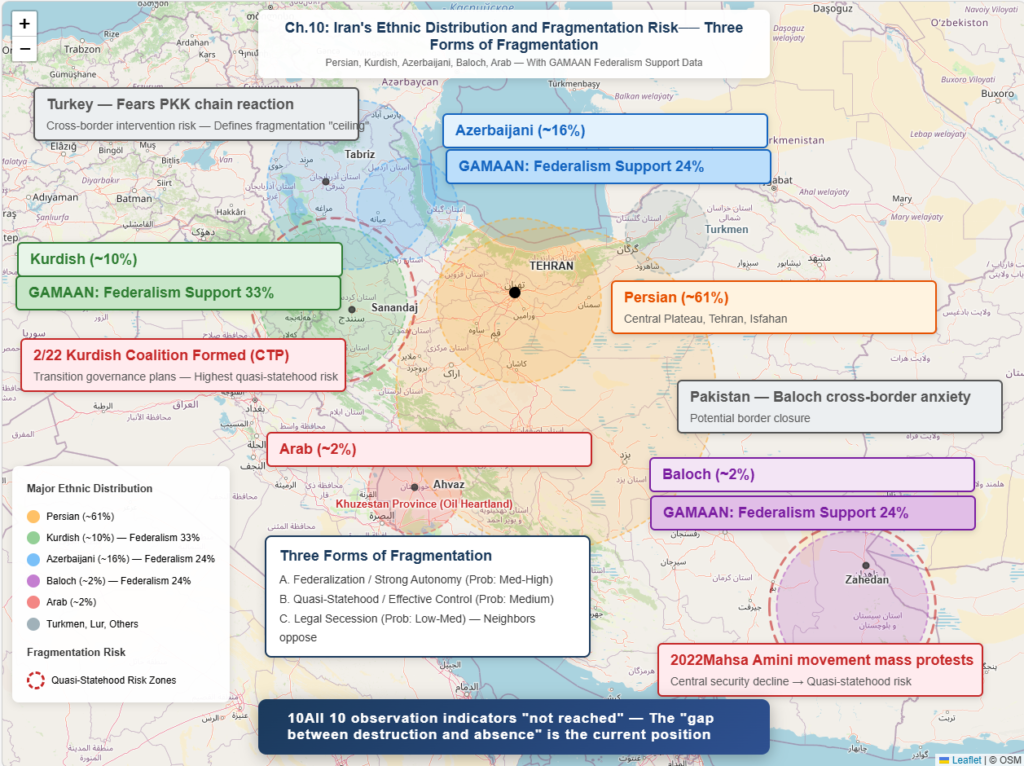
Figure 10-1: Iran’s Ethnic Distribution and Fragmentation Risk
Source: Author. Map tiles: © OpenStreetMap contributors (ODbL). Ethnic composition: CIA World Factbook. Federalism support: GAMAAN 2024. Kurdish coalition: CTP-ISW Iran Update 2/25. Baloch protests: CTP-ISW, BBC. Neighboring country concerns: RAND (2026/03).
The most critical constraint: neighbouring countries do not want Iran’s fragmentation. RAND notes Turkey and Pakistan have strong cross-border anxieties about Kurdish/Baloch independence, and would block fragmentation through border closure or counter-support [10-17]. For Turkey, Kurdish independence inside Iran is a direct extension of the PKK problem — intolerable. This ‘neighbour veto’ defines the ceiling of fragmentation.
8. China and Russia as ‘Wild Cards’ — External Forces Supporting the ‘After’
All five scenarios (Sec.5) centre on Iran’s internal dynamics. But ‘after the breaking’ outcomes are decisively influenced by China and Russia’s actions — the most underweighted variable in this analysis.
China purchases over 80% of Iran’s crude [10-18] and signed a ’25-year comprehensive strategic partnership’ in 2021 with a nominal $400B investment framework. Under Hormuz closure, whether China acts as Iran’s ‘last buyer’ is the largest external variable affecting Ch.8’s fiscal sustainability. If China stops or sharply reduces purchases fearing secondary sanctions, fiscal exhaustion proceeds per Ch.8’s Case B (~3.7 months). If China continues via shadow fleet methods, fiscal exhaustion is significantly delayed — but as Ch.9 showed, shadow fleets also transit Hormuz, so complete physical closure negates this option too.
Russia had planned to supply 48 Su-35 fighters [10-19], but post-attack chaos makes realization uncertain. More importantly, Russia can veto additional Iran sanctions at the UN Security Council. If Russia and China jointly provide a diplomatic shield to ‘extend’ the Iranian regime, the US ‘break and entrust’ design may require longer than anticipated to produce effects.
9. Observation Indicator Dashboard — How to Measure ‘The Next Is Forming’
Table 10-B: Ten Observation Indicators for Tracking ‘The Next Is Forming’
| # | Indicator | Threshold | Current Status | Implication |
| ① | Unified Transitional Council Formation | Major forces (monarchy/republic/ethnic/labour) join unified transition body | Not formed | Organisational basis for ‘next’ is absent. Kurdish coalition formed but not integrated with central-system forces. |
| ② | International Recognition | Major powers (US/EU/Japan) recognise provisional government | Not recognised | NCRI declared provisional govt but no international recognition. Pahlavi contacted US legislators but no government recognition. |
| ③ | Security Force Defection | Large-scale IRGC/police lateral switching (defection) | Unconfirmed | Ch.5: ‘suppression C2 highly degraded’ but rank-and-file defection unconfirmed. ‘Trigger created’ but ‘fact’ not yet. |
| ④ | Unified Slogan | Common ‘toward the next’ reference across all regions | Unconfirmed | ‘What to oppose’ unified. ‘What to seek’ fragmented (republic 26% / monarchy 21% / unknown 22.6%) [10-12]. |
| ⑤ | Ethnic Movement Central Integration | Kurdish/Baloch/Arab forces join unified body | Unconfirmed | Kurdish coalition formed but mutual distrust with central opposition (‘fear of Persian re-centralization’ vs ‘fear of separatism’) is barrier [10-14]. |
| ⑥ | Labour Movement Politicization | Economic demands transition to political demands | Unconfirmed | Strikes reported sporadically but organised politicization unconfirmed. |
| ⑦ | Student Movement Organisation | Consolidation into parties/political bodies | Unconfirmed | Students were frontline in 2022 Amini movement but political organisation not achieved. |
| ⑧ | Religious Defection | Senior clerics defect from regime | Limited | Guardian Council / Assembly of Experts clerics remain regime-side. |
| ⑨ | Economic Viability | Regime’s fiscal/currency maintenance capability | Declining | Ch.8: fiscal coverage ~3.7 months. Inflation accelerating. Riyal at historic lows. |
| ⑩ | International Support Mobilisation | US/European funding/training for alternative forces | Limited | NCRI lobbies but military support unconfirmed. Trump’s ‘when it’s over, take the government’ implies support absence. |
Of 10 indicators, none has been ‘reached.’ ‘Declining’ (⑨ economic viability) and ‘limited’ (⑧⑩) combined still show ‘the next is forming’ stage has not yet been reached. The regime has been ‘broken’ but ‘the next’ is invisible — this ‘gap between destruction and absence’ is the present position created by the US ‘break and entrust’ design.
10. Three-Front Pressure Intersecting — Integrated Assessment of Military, Fiscal, and Logistics
Table 10-4: Three-Front Pressure Facing Iran — Integrated Assessment
| Pressure Domain | Quantitative Value | Structural Implication | This Study’s Assessment |
| Military (Ch.7) | Overall residual ~26% Missile launch capability 25% Air defence 20% | Gap with inventory 60% proves TEL/C2 destruction effect (‘can fire but decaying’) | Launch rate declining daily. Capability for ‘large-scale coordinated counterattack sustained daily’ largely lost. But sporadic launches and Hormuz disruption persist. |
| Fiscal (Ch.8) | Monthly deficit -2,518bn/mo (Case B baseline) Coverage ~3.7 months | Deficit at 5× peacetime rapidly exhausts cushion | ~4 months until normal financing exhausted. Then transition to ‘survival mode’ via money printing/rationing/NDF drawdown. Citizens’ real living standards ground down. |
| Logistics (Ch.9) | Maritime 73 : Road 20 : Rail 7 Non-maritime total <7% of maritime | Hormuz closure = 90%+ external connectivity lost | Container, bulk food, crude export nearly all halted. Top 5 road borders <5% of maritime; volumetric substitution impossible. Chabahar <2% nationally. |
These three fronts mutually amplify. Military rebuilding requires funds and parts, but finances head toward exhaustion and logistics are severed. Fiscal survival requires export resumption, but Hormuz is blocked by IRGC itself. Logistics recovery requires war’s end, but new IRGC Commander Vahidi’s legitimacy rests on ‘external hardline.’ This triple antinomy structurally defines Iran’s ‘endurance limit.’
11. What Was the ‘Gamble’ For? — The US Side’s Minimum Objectives
If CIA greenlighted knowing IRGC hardening was likely, the US goal wasn’t ‘regime change’ itself. What was it? Three ‘minimum objectives’ can be reconstructed from open sources:
First, physically destroying Iran’s military capability — especially ballistic missiles and nuclear-related facilities. Per Ch.7, ballistic missile launch capability degraded to 25%, air defence to 20%. Nuclear facilities already struck in June 2025’s Midnight Hammer were further degraded. This ‘capability degradation’ is irreversible regardless of successor regime.
Second, fracturing regime cohesion and destabilising internal dynamics. Ch.4’s reconstructed ‘multi-centre structure’ is precisely evidence of this destabilisation. Council legitimacy language, IRGC operational language, and SNSC coordination language run in parallel without integration. Power that Khamenei alone integrated now moves while fragmented. This ‘fragmentation’ is regime weakening that impairs external action coherence.
Third, entrusting ‘after the breaking’ outcomes to Iranian domestic dynamics and external pressure. Day-after strategy absence is the logical consequence of this objective. The US never intended to ‘design what Iran becomes.’ ‘Destroy current Iran’s capability, then subsequent developments — for better or worse — are determined by internal dynamics’ — this is the gamble’s design philosophy.
12. This Study’s Final Conclusion — What the ‘Calculated Gamble’ Left Behind
The Khamenei assassination of February 28, 2026, cannot be explained by the simple narrative of ‘diplomacy failed so they attacked.’ The structure this study verified across 10 chapters is summarised as follows:
The nuclear negotiations’ ‘justification circuit’ was incrementally built from April 2025, with diplomacy and military running in parallel from the start (Ch.1). Past limited retaliation’s ‘learning effect’ enabled the leap to history’s first supreme leader assassination (Ch.2). Forces were redeployed from Venezuela over 58 days (Ch.3). Persian-language primary sources exposed ‘announcement authority = real power’ structures that English media missed (Ch.4). Decapitation’s essence was ‘lateral integration rupture’ rather than ‘loss of the top,’ and Khamenei himself had institutionalized succession through pre-positioning (Ch.5). The intelligence process scored ‘High’ across all six stages — an activation of the Stuxnet-era capability pattern (Ch.6). Air defence and ballistic missile residuals were quantified by district and base, totaling ~26% (Ch.7). Hormuz closure inflated fiscal monthly deficit to 5× peacetime, exhausting coverage in ~3.7 months (Ch.8). All non-maritime modes combined amount to less than 7% of maritime; substitution is impossible (Ch.9).
And CIA, knowing all of this — at least in outline — greenlighted the attack while projecting IRGC hardline succession as most likely. The most consistent conclusion is ‘a gamble with acknowledged uncertainty,’ and the most-frequent scenario is IRGC-led hardening.
How history judges this ‘gamble’ depends on future developments — the regime’s endurance, the international community’s response, and Iranian citizens’ choices. What this study can provide is ‘the structural foundation for that judgment.’ Numbers don’t lie. But numbers alone don’t determine what to build ‘after the breaking.’ That belongs to the domain of human choice, beyond this study’s scope.
‘Dissecting the Khamenei Decapitation’ — this 400+ page investigation reveals the multifaceted nature of a single fact, and the depth of uncertainty beyond it. The author hopes readers will use this structural analysis as material for their own judgment.
Chapter 10 — References
[10-01] Reuters, “Prior to Iran Attacks, CIA Assessed Khamenei Would Be Replaced by Hardline IRGC” (CIA pre-assessment, ~2 weeks prior, multiple scenarios, no definitive probability) [Link]
[10-02] BBC Verify, “Iran Strikes: How B-2 Bombers and Decoys Were Used” (B-2 flight paths, decoys, Tomahawk simultaneous strikes = ops preparation parallel to diplomacy) [Link]
[10-03] CFR, “Gauging the Impact of Massive U.S.-Israeli Strikes on Iran” (Attack date agreed ~2 weeks prior) [Link]
[10-04] Reuters, “US Lawmakers See No Trump Plan for Iran Following Strikes” (Day-after absence, ground force opposition, ‘You break it, you own it’ denial) [Link]
[10-05] PBS NewsHour, “Read Trump’s Full Statement on Iran Attack” (‘Citizens shelter / take the government,’ amnesty for laying down weapons)
[10-06] Reuters, “Trump Says Conflict With Iran Could Last Four Weeks” (‘4 weeks’ statement) [Link]
[10-07] CBS News, “CIA Intelligence: US-Israel Strike on Ayatollah Ali Khamenei” (CIA months-long tracking, meeting window) [Link]
[10-08] Reuters, “Trump Tells Iranians Keep Protesting, Says Help Is on Its Way,” 2026/01/13 [Link]
[10-09] The Guardian, “How Israeli Sleight and US Might Led to the Assassination of Ali Khamenei” (Israeli HUMINT × US technical ISR division of labour) [Link]
[10-10] Al Jazeera, “Analysis: Will Iran’s Establishment Collapse After the Killing of Khamenei” (Garrison state risk) [Link]
[10-11] The Conversation, “Despite Massive US Attack and Death of Ayatollah, Regime Change in Iran Is Unlikely” [Link]
[10-12] GAMAAN, “Iranians’ Political Preferences in 2024” (70-80% oppose regime, republic 26% vs monarchy 21%, 22.6% ‘insufficient knowledge’) [Link]
[10-13] POLITICO, “Reza Pahlavi and Iran Takeover,” 2026/03/01 (31% support, ‘no ground game in Iran’) [Link]
[10-14] CTP/ISW, Iran Update, February 25, 2026 (Kurdish anti-regime coalition formation, transition governance plans) [Link]
[10-15] RFE/RL, “Iran Exiled Kurdish Alliance” (PDKI leader: transition governance plan) [Link]
[10-16] GAMAAN, “Iranians’ Political Preferences in 2024” (Federalism: Kurdistan 33%, W.Azerbaijan 24%, Sistan-Baluchestan 24%) [Link]
[10-17] RAND, “Who or What Will Replace Iran’s Supreme Leader Ali Khamenei” (Turkey/Pakistan cross-border anxiety, neighbour veto on fragmentation) [Link]
[10-18] Reuters, “China Teapot Refiners Cushioned Against Iran Oil Disruption,” 2026/01/13 (China >80% of Iran crude) [Link]
[10-19] Alma Research, “Iran Situation Assessment February 2026” (Su-35 ×48 plan) [Link]
[10-20] Vox, “Khamenei Dead: Iran Regime Change Airpower History” (Airpower limits, ‘may produce solidarity’) [Link]
Leave a Reply